PEMDAS
PEMDAS is an acronym for the words Parenthesis, Exponents, Multiplication, Division, Addition, Subtraction. It is an notable acronym for the order of operations in mathematics.
Order of Operation Calculator
PEMDAS Calculator is a tool that helps you to solve order of operations online. Mathematics is fun, but most of us study the boring textbook maths. The subject is exciting if one learns it with examples, puzzles, and games. The world of numbers, calculations, and formulas are helpful in every aspect of life. In this article, we are going to discuss one of the most basic orders or rules of operations in mathematics known as PEMDAS.
Type your equation solve it step by step. Example: (5+2)-6 or 4*9/3
At first, the name sounds complicated, but in reality, it is an acronym of “parenthesis, exponents, multiplication, division, addition, subtraction.” If you still find it difficult, then, let's make it easy and fun to remember. Below are an unusual but fun way to remember the PEMDAS rule:
- Purple Elephants May Destroy A School
- Please Eat My Dad's Apple Sauce
- Please Excuse My Dear Aunt Sally
- Please Eat My Dear Annoying Sister
- Pink Elephants Make Dandy Apple Sauce
While these are just examples, students can always personalize it to remember it for a lifetime.
While we have only talked about what PEMDAS stands for, let's see where we can make use of this mathematics rule. Let's say you were given this simple question to simplify - 5 + 3x4. How would you do it? Would you first add and then multiply or multiply first and then add to get the answer. Let us try both ways and see what we get.
Question - 5 + 3x4
Solution A - (5 + 3) x 4 = 32
Solution B - 5 + (3x4) = 17
Which of these solutions is correct? It entirely depends on how a student looks at the problem. However, such freedom will shake the basic principle of mathematics as we will end up with multiple answers. Therefore, to prevent any such confusion, there are established rules in the subject dating back to the 1500s known as ‘order of operations,’ operations being multiplication, grouping, subtraction, division, addition, and exponentiation.
There are numerous collection of rules, and one of the most common is PEMDAS, that defines which operations to solve first in a given mathematical expression. In simple words, the rule tells us the order of what should one evaluate first in a particular expression.
Going back to one of our fun mnemonic phrases - Purple Elephants May Destroy A School, we know the order will be parentheses, exponents, multiplication, division, addition, subtraction. So always one must remember that parenthesis will outweigh exponents and similarly the exponents will outrank multiplication and division and the latter supersedes addition and subtraction.
Now that the concept is clear, let's look at our first question and see if solution A or solution B is the correct. Following PEMDAS rule, solution B is the right answer, as one has first to simplify multiplication and addition.
Another essential thing to remember is that all operations are divided into four ranks, which are as follows:
- Parentheses (simplify inside them)
- Exponents
- Multiplication and Division (from left to right)
- Addition and Subtraction (from left to right)
So what does one do when there are more operations of the same rank, for instance - multiplication and division. Let’s take an example to simplify the rule.
Question - 20 ÷ 4 × 5
Solution - Even though multiplication outranks division, one must first divide and then multiply. According to the rule, when there are multiple operations of the same rank, one must operate left to right. So the answer to the solution is (20 ÷ 4) x 5 = 25 and not 20 ÷ (4x5) = 1.
In case you are not sure what is the correct order of hierarchy, it is best to solve the question on a calculator and see the answer. Most calculators are programmed with an order of operations rule.
PEMDAS CALCULATOR
PEMDAS calculator is just a virtual calculator to calculate basic and advanced mathematical expressions. Students can use the calculator if they are not sure which operation they need to perform first. The calculator will provide the correct answer, and students can check if they have done it correctly.
To solve a problem, students have to enter the question into the box and then click to get the answer.
Note:Students must not use the calculator for all expression and instead try to solve it themselves. Use the PEMDAS calculator only when you have attempted to solve the expression multiple times by yourself.
Difference between PEMDAS and BODMAS
BODMAS is another term for PEMDAS, and it is the same order of operation. Commonly, speakers of the British English use the term. BODMAS is also an acronym which is short for Bracket, Order/Of, Division, Multiplication, Addition and Subtraction.
Akin to PEMDAS, BODMAS rule states that one must first solve expression in brackets and then succeeded by powers and roots. The next comes division, and multiplication, followed by addition and subtraction. One significant distinction in both acronyms is that in the British English version - division precedes multiplication, which is a clear indication that multiplication and division are of the same rank. Therefore, students must solve expression with multiple same rank operations from left to right.
Solving from Inside Out
While PEMDAS was established to prevent any miscommunication or confusion when solving a mathematical expression, the rule itself creates its fair share of confusion. The confusion arises mostly on deciding the hierarchy of operations when they are on the same rank.
Directly, solving it from left to right will not help as at times, those operations are not equal. Therefore, it is best to solve problems at times from the inside out instead of left-to-right. Sounds confusing, right? Let's look at it with examples to make it simple and understandable.
Question A - 5 + 52
Solution - To solve the above problem, students must first simplify the exponent and then add.
5 + 52= 5 + 25 = 30
Question B - 5 + (4 + 1)2
Solution - Now, in this particular equation, one must first simplify the parenthesis before attempting to solve the exponent and then only do the addition.
5 + (4 + 1)2 = 5 + (5)2 = 5 +25 = 30
Question C - 5 + [–1(–4 – 1)]2
Solution - Approaching the parentheses from left-to-right will lead to errors and therefore it is best to solve from inside out. So, we will solve the curve brackets first then the square brackets and then only the rest of the expression. Follow the below step-by-step instruction:
5 + [–1(–4 – 1)]2 = 5 + [–1(–5)]2
= 5 + [5]2
= 5 + 25
= 30
The squared brackets are used only to make it easy to understand which grouping character are used. Commonly, brackets and curvy-braces are often used when there are multiple overlapping brackets. Let’s look at the below question:
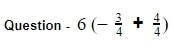
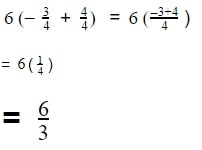
Solution - Follow the steps to simplify the expression
Other Examples
Generally, most students make mistakes in the order of operations when there are parentheses, exponents and minus signs involved. The below examples will help them solve expressions easily,
Question A - 4 – 3[4 –2(6 – 3)] ÷ 2
Solution - To simplify the above expression, students must do it from the inside out. Will follow this order to solve the problem - parentheses, square brackets, division, and addition. Students must remember to always simplify the grouping parts and then do the division and addition or subtraction.
5-4[5-3(8-4)] ÷ 2
= 5-4[5-3(4)] ÷ 2
= 5-4[5-12] ÷ 2
= 5-4[-7] ÷ 2
= 5 + 28 ÷ 2
= 5 + 14
= 19
If you look closely at the end of the solution, the division comes prior to addition, hence it is simplified 5 +14 and not 33 ÷ 2.
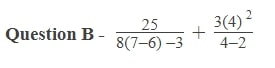
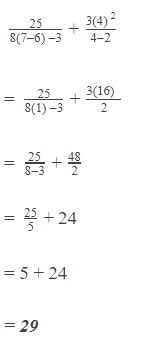
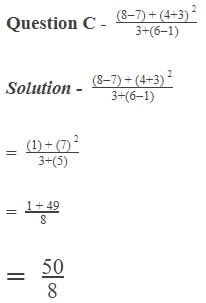
Solution - Fractions can at times be confusing to solve and hence we are going to simplify the above mentioned fractional mathematical expression. The trick is to simplify the numerator and denominator independently. Also, one must remember to reduce the fractional form before implying addition or subtraction.
In case the fractions are together and not separated than one has to simplify to get a fraction that can be reduced. Let’s have a look at the below example and use the PEMDAS rule.
While PEMDAS clears a lot of confusion when it comes to solving mathematical expressions, there still remains ambiguity within the PEMDAS rules. Many calculators or software packages solve mathematical expression differently, mostly the variation arising in the order of operation. For example, the unary operator is also known as ‘minus’ is interpreted differently in written and digitally.
So the mathematical expression -72 is solved as 0 -(72) = - 49
However, the same expression on Microsoft Excel is simplified as (-72) = 49. It happens because the minus sign has greater precedence than exponentiation in these programs.
So if in doubt, it is always best to ask your teacher. The above covers the basics of PEMDAS rules or the order of operations and makes it easy for students to understand and solve mathematical expressions.